
Considering LASIK Surgery in Mumbai?
Get a detailed, clinical LASIK eligibility assessment with Dr. Jugal Shah, Senior Ophthalmologist and Refractive Surgeon with over 30 years of experience.
- Personalized corneal and spectacle power evaluation
- Contoura LASIK & Bladeless Femto-LASIK options
- Transparent guidance on suitability, risks, and recovery
Book LASIK Assessment
Fill out the details below. Our care team will call to confirm your preferred OPD slot.
30+ Years
Ophthalmology practice since 199298,000+ Surgeries
Surgical precision applied to every assessmentSince 2002
Malad West, MumbaiWhat is LASIK?
LASIK (Laser-Assisted In Situ Keratomileusis) is a painless, day-care LASER procedure that reshapes the cornea using an excimer LASER to correct refractive errors such as myopia (short-sight), hypermetropia (long-sight), and astigmatism.
In a normal eye, light passes through the cornea and lens and focuses sharply on the retina, giving clear vision. When light focuses in front of the retina (myopia), behind it (hypermetropia), or at different points (astigmatism), vision becomes blurred. LASIK corrects this focusing power by reshaping the cornea.
At Maa Nursing Home and NetraJyoti Eyecare Centre, we have a dedicated LASIK clinic and have successfully treated thousands of patients, offering both Contoura LASIK and Bladeless Femto-LASIK, performed by Dr. Jugal Shah. LASIK can typically correct myopia up to –18.0 D, hypermetropia from +1.0 D to +6.0 D, and astigmatism from –1.0 D to –6.0 D.
Could LASIK Be Suitable for Your Eyes?
LASIK eligibility depends on more than just spectacle power. Dr. Jugal Shah evaluates your corneal thickness, eye topography, age, and medical history.
You may be considered if you:
- ✓ Are above 18 years of age
- ✓ Have stable spectacle power for at least 6 months
- ✓ Have suitable corneal thickness and shape
- ✓ Do not have uncontrolled diabetes, pregnancy-related hormonal changes or other major systemic issues
Another option may be advised if:
- ✕ You have diseases that cause corneal thinning or bulging, or a strong family history of it
- ✕ Your cornea is too thin, or you have very large pupils
- ✕ You have severe near-sightedness beyond safe limits
- ✕ You have significant age-related eye changes (e.g. advanced cataract, macular disease)
- ✕ You play contact sports with frequent blows to the face
Pre-LASIK Evaluation
Before surgery, a detailed assessment is done to ensure safety, including a routine eye examination, Keratometry (to measure the shape and curvature of the cornea), and Pachymetry (to measure corneal thickness). Based on these measurements, the surgeon plans exactly where and how much of the cornea needs reshaping.
How is LASIK Performed?
The cornea accounts for about 70% of the eye's focusing power. LASIK uses a computer-controlled excimer LASER (a cool ultraviolet LASER) to reshape the cornea precisely. Local anaesthetic eye drops are used - no injections. A suction ring is applied, and a thin corneal flap is created (either manually or with a Femto-second LASER). The flap is lifted, and the excimer LASER reshapes the underlying corneal tissue. The flap is then repositioned and naturally adheres without stitches.
At our centre, LASIK is performed using Contoura LASIK (topography-guided LASIK with a manually created flap) or Bladeless LASIK (flap created using Femto-second LASER for enhanced precision). The entire procedure usually takes about 15–20 minutes. Both eyes can often be treated in the same sitting, and no hospitalization is required.
Thinking about getting rid of glasses? Read our comprehensive guide: Is LASIK Surgery Safe? Everything You Need to Know
Risks & Temporary Side Effects
LASIK is a safe and widely performed procedure, but as with any surgery some patients may experience temporary dry eyes (managed with lubricating drops), glare, halos or increased light sensitivity, and occasional double or fluctuating vision in the early days. Serious complications or permanent loss of vision are rare - your doctor will discuss all pros and cons before surgery.
Precautions Before & After LASIK
- • Stop soft contact lenses 48–72 hours before surgery; RGP lenses at least 15 days before
- • On the day: wash your hair, avoid eye makeup, creams, perfumes and deodorants
- • Wear sunglasses for about 1 week after surgery
- • Avoid splashing water directly in the eyes for ~1 month; no head bath for 1 week
- • No swimming for at least 1 month; use prescribed eye drops exactly as advised
Recovery & Results
Most patients notice clearer vision within the first 24 hours, with vision typically stabilising within about 2 weeks. You can usually return to routine work in 2–3 days after the procedure, depending on your job profile. While glasses or contact lenses can improve vision, LASIK corrects the underlying focusing issue by reshaping the cornea - addressing the root cause of the refractive error.
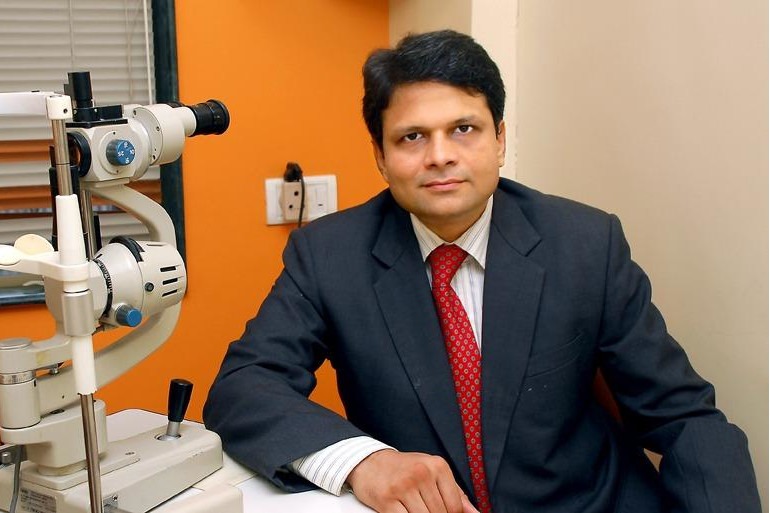
Meet Dr. Jugal Shah
M.S., D.N.B., D.O.M.S., F.C.P.S.
“The first step is not selecting a LASIK package. It is understanding whether vision-correction surgery is appropriate for your individual eyes.”